Description
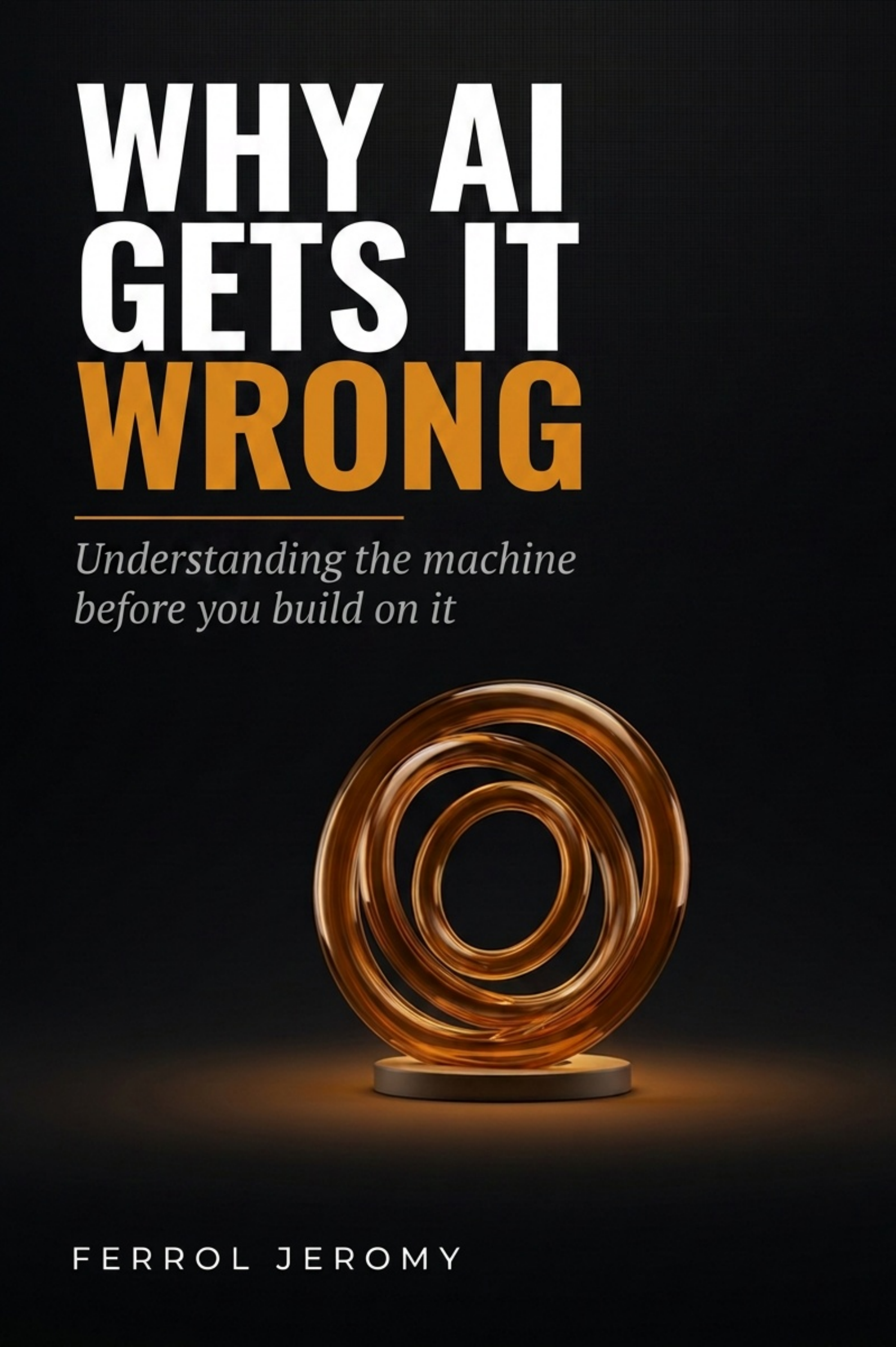
$19.00
An airline was ordered to pay for a refund policy its chatbot invented. A legal brief cited six court cases that did not exist. Neither failure looked like a failure. Both read like every correct answer the system had ever produced.
A short book about why that happens, what it costs, and where the leverage actually is. Not prompts. Not tools. The environment you build around the machine.
PDF. 37 pages. Readable in an evening.
Description
Understanding the machine before you build on it
Modern AI is convincing enough that we hand it qualities it does not have. We assume it understands. We assume it knows. We assume it remembers, and that it thinks. Almost every serious mistake people make with AI traces back to one of those four assumptions.
This book is about what does not change as the tools change: how these systems produce language, why that mechanism makes certain failures inevitable, and what actually reduces them.
What is inside
- The biggest misunderstanding about AI. Why fluency tells you nothing about accuracy, and why you cannot verify an answer by asking it to vouch for itself.
- How language models actually work. Tokens, prediction, and the context window, explained without mathematics or code.
- Why AI makes mistakes. Six distinct failure modes that all look identical on the surface, and the different fix each one needs.
- Context is everything. The Context Four (presence, accuracy, focus, order), a diagnostic you can run in under a minute.
- The incompetent expert. What these tools do to the judgment of the person using them, and to the organisations that stop producing bad first drafts.
It closes with a one-page diagnostic checklist for the next time a model gives you an answer you do not trust.
Who it is for
People who have to make decisions about AI systems rather than train them from scratch: founders deciding whether to trust an output, product managers defining a reliable product, advisers guiding clients, and operators placing a model inside a workflow people depend on. Developers are welcome. The mechanics will be familiar, and the framing may still be useful.
No technical background is assumed. There is no mathematics. There is no code.
What it is not
It is not a prompt guide. There are no templates, no magic phrases, no personas to copy. Prompting is the smaller half of the problem, and the imbalance is why so many AI projects look impressive in a demo and fail in production.
Public incidents are documented in the notes. Constructed scenarios are labelled and contain no invented statistics.
First edition, 2026. Delivered as a PDF download immediately after purchase.